ZEFES is a four-year innovation action focused on bringing nine long-haul truck configurations – both battery electric (BEV) and fuel cell electric (FCEV) – into real-world operation across strategic TEN-T corridors. By integrating vehicle technology development with operational trials in active logistics environments, the project seeks to build robust evidence on performance, scalability, and cost-effective deployment pathways for zero-emission long-distance haulage.
On the 25th of February 2026, the ZEFES consortium brought together industry leaders and stakeholders at ECS Zeebrugge for a dedicated Symposium titled »Celebrating a Milestone in the Electrification of Intermodal Cross-Border Long-Haul Transport.« The event highlighted major advancements within the EU–funded ZEFES project, which aims to accelerate the decarbonization of long-distance and cross boarder freight through large-scale deployment and testing of zero-emission heavy-duty vehicles with megawatt charging.
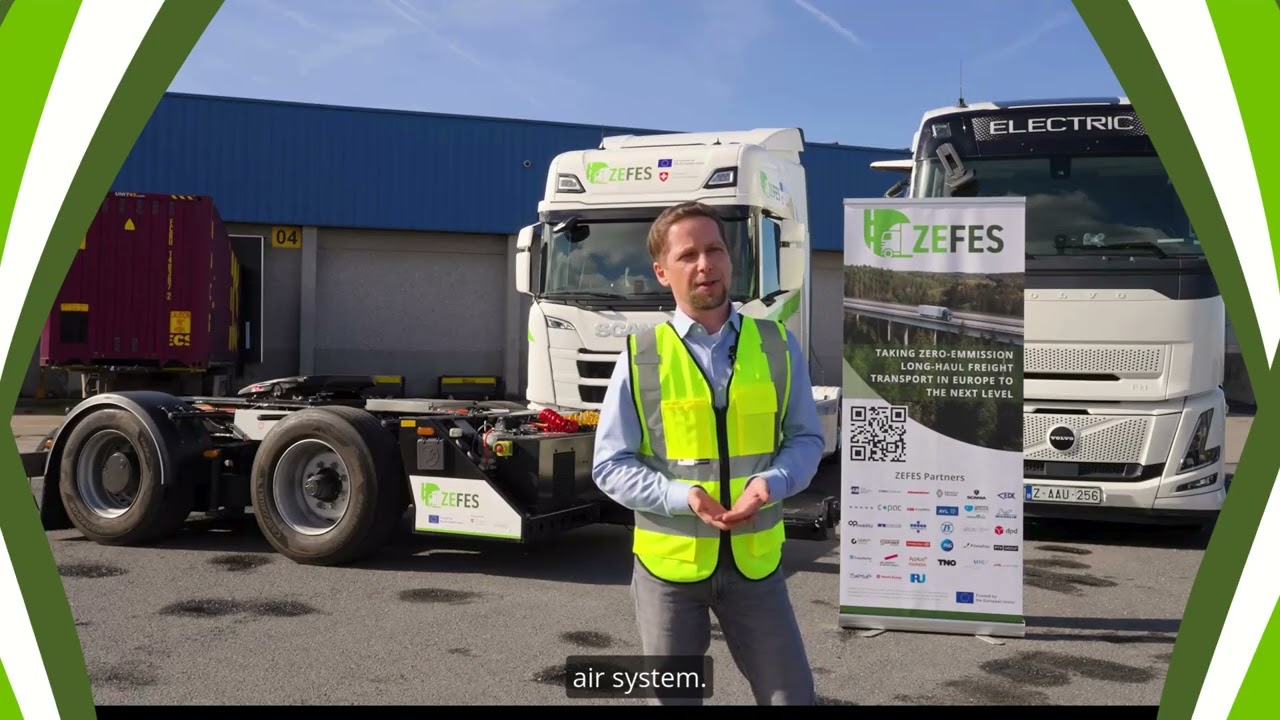
Hosted by Procter & Gamble (P&G) in collaboration with ECS, the Symposium brought together logistics operators, technology providers, vehicle OEMs, infrastructure developers, and policy stakeholders to examine Europe’s readiness for electrified heavy-duty transport. Attendees had the opportunity to observe first-hand news on the latest status of the ZEFES project and a series of technical demonstrations.
The project update covered:
- Overview of ZEFES demonstrations across Europe
- Vehicle technologies, prime and second movers
- Digital platform supporting ZE-HDVs in daily operations
- Battery Electric Vehicles operating at up to 64 tonnes GCW
- Megawatt Charging System (MCS) infrastructure delivering charging power up to 1.2 MW
- Electric European Modular System (EMS) configurations supporting high-capacity freight movements
- A battery-electric dolly designed for range extension in electric EMS configurations, hybridization of conventional truck-duotrailer combinations, and automation-ready standalone operation on yards
These demonstrations illustrated meaningful progress in addressing operational barriers to electrified long-haul transport, particularly around high-power charging, vehicle weight capability, and automated yard logistics. For the trade sector, the event offered concrete insights into how zero-emission technologies can be integrated into complex intermodal supply chains.
As partner of the ZEFES project, Fraunhofer IVI presented an electrified converter dolly (e-dolly) that enables the efficient handling of long EMS vehicle combinations in yards and terminals. By splitting the vehicle combination, the e-dolly can (automatically) maneuver an attached semitrailer independent from the towing vehicle. This allows the system to operate on existing infrastructure that is currently designed for conventional tractor-semitrailer-combinations. On public roads, the e-dolly can support the electrification of long EMS vehicle combinations, especially for demanding mission profiles.
 Fraunhofer Institute for Transportation and Infrastructure Systems IVI